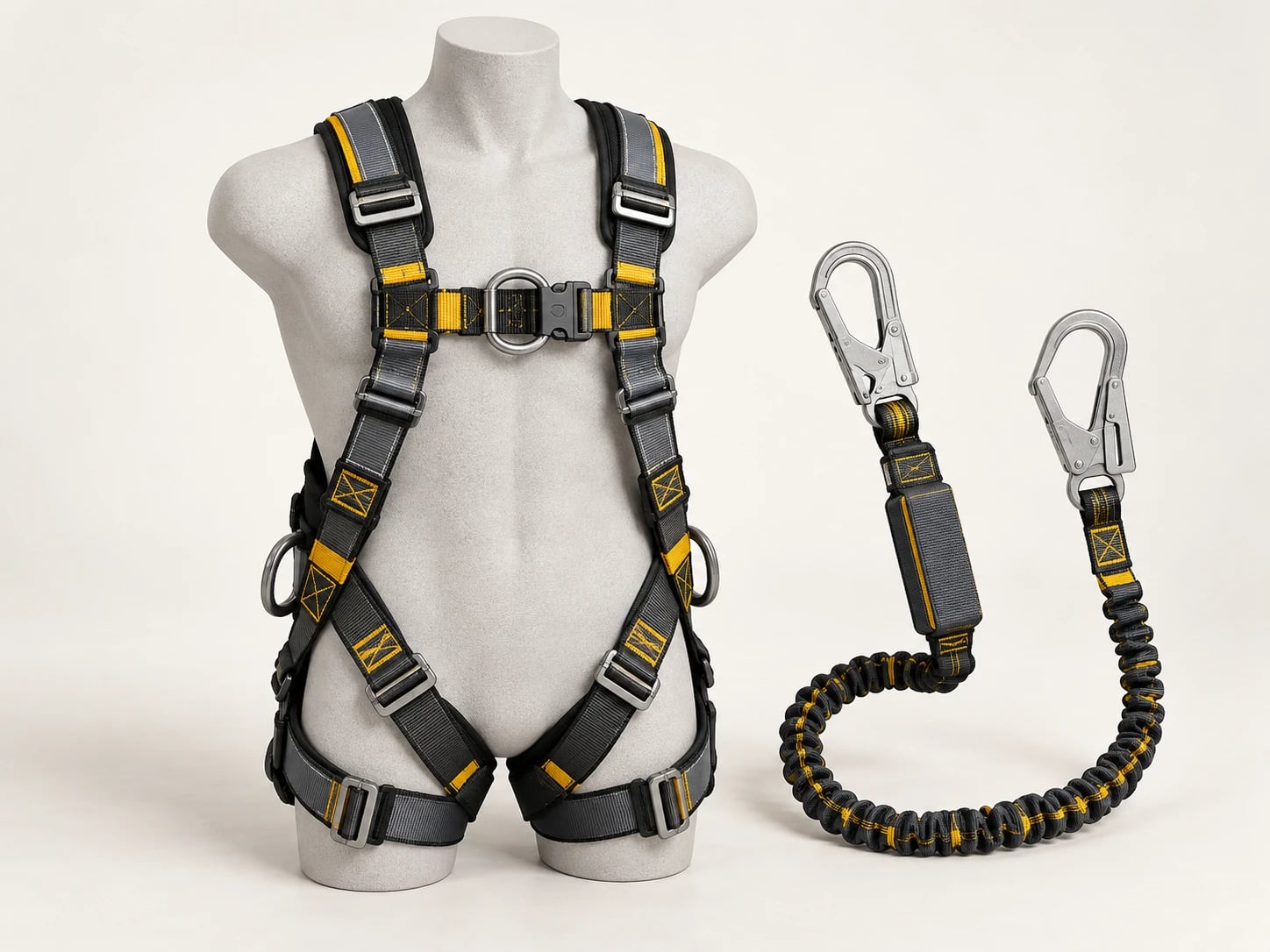
Fall Arrest Harness & Height Safety Specifications
The figures below describe typical industry specifications for this class of equipment rather than a single fixed model. Use them to scope a requirement, then confirm exact figures against the supplied unit before purchase.
| Specification | Typical value |
|---|---|
| Harness standard | EN 361 full body, or ANSI/ASSP Z359.11 |
| Attachment points | Dorsal D-ring; optional sternal and side positioning rings |
| Webbing | Polyester, 44–45 mm, ≥15 kN rated |
| Lanyard type | Energy absorbing (EN 355) or self-retracting (EN 360) |
| Maximum arrest force | ≤6 kN at the body |
| Energy absorber deployment | Up to 1.75 m extension |
| Required fall clearance | ≈6.5 m for a 2 m shock-absorbing lanyard |
| Anchor point strength | ≥12 kN, or engineered to 2× maximum arrest force |
| Connectors | Self-closing and self-locking; verify marked strength, loading axis and the applicable system standard. Gate strength is a separate rating. |
| Inspection | Pre-use by wearer; formal 6-monthly by competent person |
| Service life | Typically 5–10 years from manufacture; sooner with UV exposure |
| Rescue plan | Mandatory. Suspension trauma can be fatal within 15–30 minutes |
Fall Arrest Harness & Height Safety: Uses and Applications
- Shaft collar and headframe work
- Plant structure and conveyor maintenance
- Tank, silo and confined space entry
- Roof and elevated walkway access
- Drill rig mast work
Maintenance Schedule
Most premature failures in this equipment class trace back to a missed routine check rather than a design fault. The intervals below are a practical starting schedule; adjust them to your duty cycle and the manufacturer manual.
| Interval | Task |
|---|---|
| Before every use | Wearer inspection of all webbing, stitching, D-rings and connectors; check the energy absorber indicator has not deployed. |
| After any fall | Withdraw the entire system permanently. Harness, lanyard and connectors are single-event equipment and cannot be returned to service. |
| Monthly | Supervisor spot check of issued equipment and inspection records. |
| Six-monthly | Formal documented examination by a competent person, with tagging. |
| By service life | Replace at the manufacturer stated life; UV degradation of webbing is progressive and not reliably visible. |
Frequently Asked Questions
How much clearance does a fall arrest system need?
For a typical 2 m shock-absorbing lanyard: lanyard length 2 m, plus absorber deployment up to 1.75 m, plus worker height below the D-ring about 1.5 m, plus a 1 m safety margin, giving roughly 6.5 m of clear space below the anchor. If the drop is shorter than that, a shock-absorbing lanyard is the wrong choice and a self-retracting lifeline or restraint system is required.
Can a fall arrest harness be reused after a fall?
No. Once a fall has been arrested, the harness, lanyard and connectors have absorbed a large impact and their remaining strength is unknown. The whole system must be destroyed and replaced, not inspected and returned to use.
Why is a rescue plan mandatory?
Because arresting the fall is only half the problem. A worker left suspended in a harness can develop suspension trauma, blood pooling in the legs leading to unconsciousness, within 15 to 30 minutes. If there is no means to retrieve them quickly, the fall arrest system has only changed how they die.
What anchor strength is required?
At least 12 kN for a single user, or an anchor engineered and certified to at least twice the maximum arrest force. Improvised anchors such as pipework, handrails and scaffold couplers are a frequent and serious failure point, because they were never designed for shock loading.
Supply and Delivery Across Tanzania
Bart Mining supplies fall arrest harness & height safety and related equipment to mining operations throughout Tanzania, with primary coverage of the Lake Victoria Goldfields (Mwanza, Kahama, Geita, Shinyanga and Bukombe), alongside the Lupa Goldfields around Chunya and Mbeya, and delivery nationwide from Dar es Salaam.
Manufacturer or supplier of this equipment? Bart Mining sells machinery like the fall arrest harness & height safety to buyers across Tanzania through its local market partnership.
Safety and scope references: Petzl fall-clearance guidance