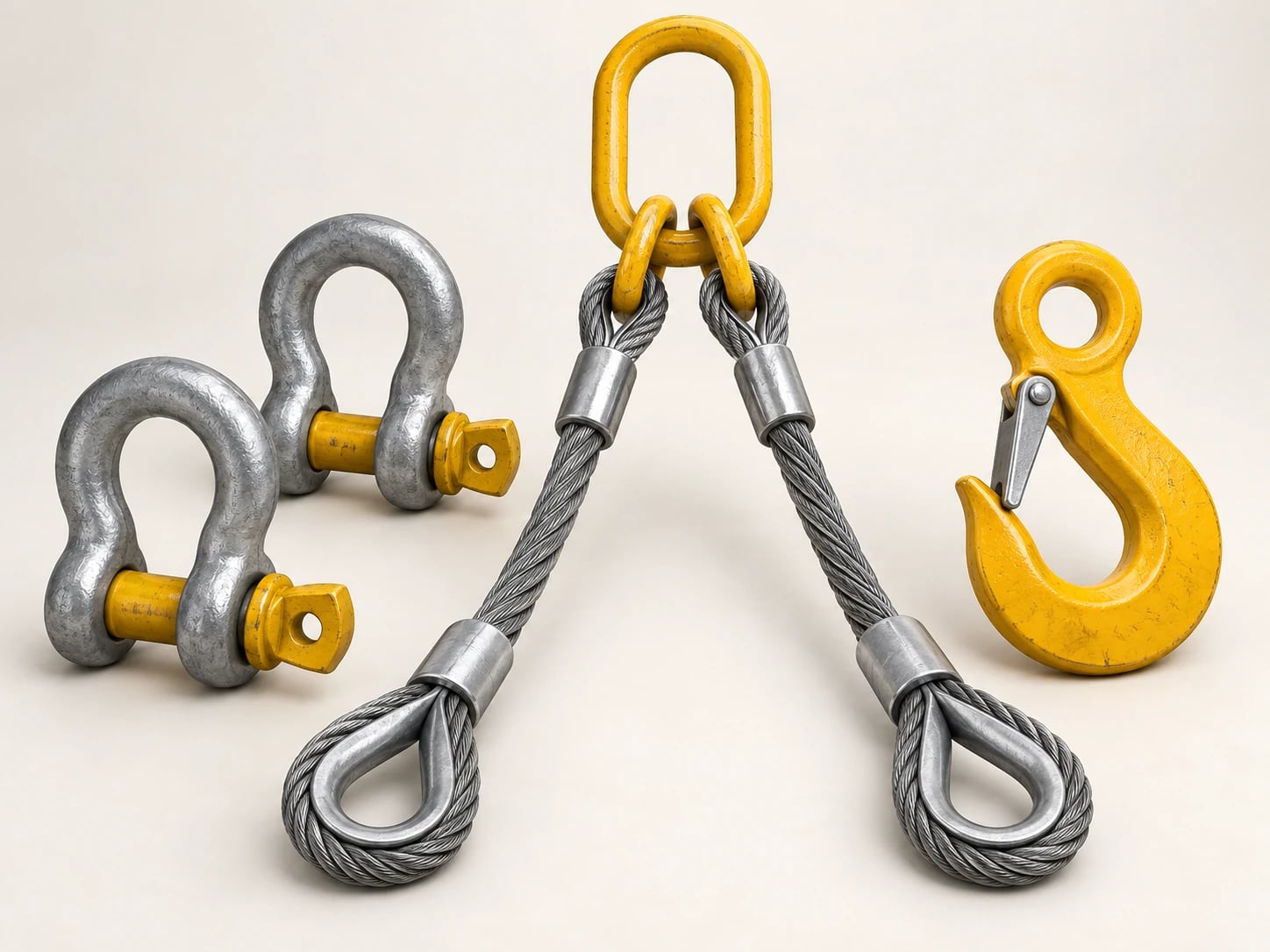
Wire Rope, Slings & Lifting Tackle Specifications
The figures below describe typical industry specifications for this class of equipment rather than a single fixed model. Use them to scope a requirement, then confirm exact figures against the supplied unit before purchase.
| Specification | Typical value |
|---|---|
| Rope construction | 6×19, 6×36 or 8×19, IWRC or fibre core |
| Common diameters | 8–26 mm for small to medium mining duty |
| Tensile grade | 1770 or 1960 N/mm² |
| Finish | Bright or galvanised; galvanised preferred in wet shafts |
| Safety factor (goods) | 5:1 minimum against minimum breaking load |
| Safety factor (personnel) | 8:1 or higher per applicable regulation |
| Sling types | Single, two, three and four leg; endless and eye-and-eye |
| Terminations | Ferrule-secured, spliced or swaged; wedge sockets for drum ends |
| Shackles | Bow and dee, grade 6 or higher, marked with WLL |
| Discard standard | ISO 4309: broken wires, diameter reduction, corrosion, deformation |
Wire Rope, Slings & Lifting Tackle: Uses and Applications
- Winch and hoist drum rope
- Lifting slings for plant installation
- Guy ropes and structural bracing
- Recovery and towing on haul roads
- Conveyance attachment and safety chains
Maintenance Schedule
Most premature failures in this equipment class trace back to a missed routine check rather than a design fault. The intervals below are a practical starting schedule; adjust them to your duty cycle and the manufacturer manual.
| Interval | Task |
|---|---|
| Before each use | Visual check of the full length for broken wires, kinks, crushing, corrosion and heat damage; confirm identification tag and WLL are legible. |
| Weekly | Lubricate running ropes with a penetrating wire rope dressing; wipe and re-inspect terminations. |
| Monthly | Measure rope diameter at several points and compare against nominal; log the trend rather than the single reading. |
| Six-monthly | Thorough examination by a competent person with written record for all lifting accessories. |
| On any doubt | Withdraw from service immediately. Rope condition is not recoverable and there is no safe field repair for a damaged lifting rope. |
Frequently Asked Questions
When must a wire rope be discarded?
Under ISO 4309, on any of: broken wires exceeding the permitted number per lay length for the rope construction, diameter reduction beyond the allowable percentage, severe corrosion or pitting, core protrusion, kinking, birdcaging, crushing, or heat damage. Any one criterion alone is sufficient. They are not cumulative thresholds.
What does IWRC mean and do I need it?
Independent Wire Rope Core: the rope core is itself a small wire rope rather than fibre. It gives roughly 7% higher breaking load, much better crush resistance on multi-layer drums and better performance at temperature. For winch drum duty it is generally the right choice; fibre core is more flexible and suits some sling applications.
How do I calculate safe working load for a multi-leg sling?
It depends on the angle between legs, not just leg count. As the included angle widens, tension in each leg rises sharply. At 120° each leg carries the full load, doubling the tension versus a vertical lift. Use the rated capacity table for the actual angle, and never assume two legs means double capacity.
Can a damaged wire rope be repaired?
No. There is no acceptable field repair for a lifting rope with broken wires or core damage. Splicing is a manufacturing operation performed under controlled conditions on undamaged rope, not a site remedy. A rope meeting any discard criterion is scrap.
Supply and Delivery Across Tanzania
Bart Mining supplies wire rope, slings & lifting tackle and related equipment to mining operations throughout Tanzania, with primary coverage of the Lake Victoria Goldfields (Mwanza, Kahama, Geita, Shinyanga and Bukombe), alongside the Lupa Goldfields around Chunya and Mbeya, and delivery nationwide from Dar es Salaam.
Manufacturer or supplier of this equipment? Bart Mining sells machinery like the wire rope, slings & lifting tackle to buyers across Tanzania through its local market partnership.