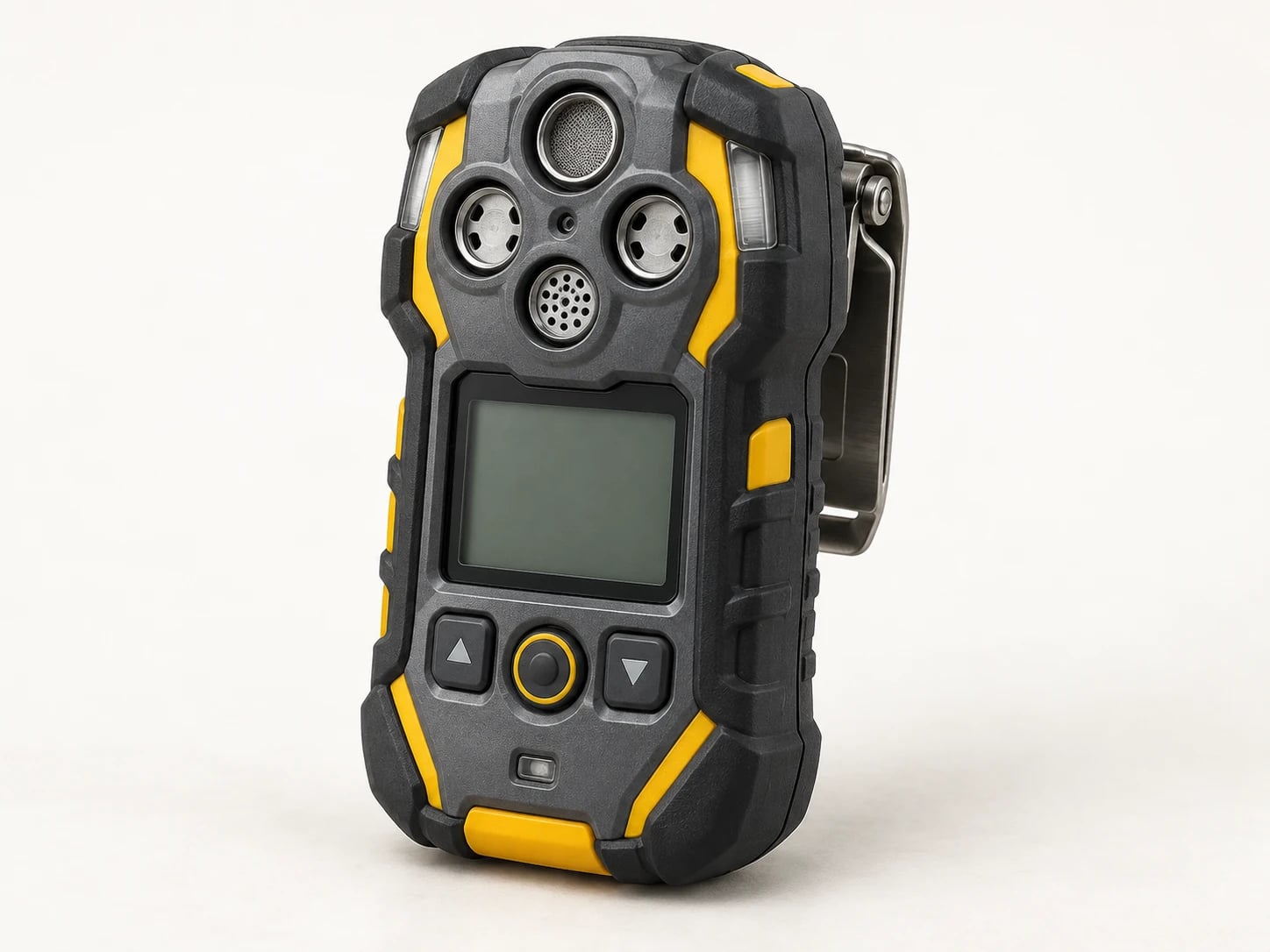
Multi-Gas Detection Monitor Specifications
The figures below describe typical industry specifications for this class of equipment rather than a single fixed model. Use them to scope a requirement, then confirm exact figures against the supplied unit before purchase.
| Specification | Typical value |
|---|---|
| Standard sensor set | O₂, CO, H₂S and combustible gas (LEL) |
| Oxygen range | 0–30% vol; alarms at 19.5% low and 23.5% high |
| Carbon monoxide range | 0–1,000 ppm; typical alarms 25 and 100 ppm |
| Hydrogen sulphide range | 0–200 ppm; typical alarms 5 and 10 ppm |
| Combustible gas range | 0–100% LEL; typical alarms 10% and 20% LEL |
| Sensor types | Electrochemical for toxics; catalytic bead or IR for LEL |
| Alarms | Audible ≥95 dB, visual and vibrating |
| Response time | T90 typically under 30 seconds |
| Battery life | 12–24 h continuous |
| Ingress protection | IP66–IP68 |
| Hazardous area rating | ATEX or IECEx intrinsically safe |
| Datalogging | Continuous, downloadable for compliance records |
Multi-Gas Detection Monitor: Uses and Applications
- Pre-entry testing of shafts, winzes and old workings
- Confined space entry certification
- Continuous personal monitoring underground
- Post-blast re-entry clearance
- Welding and hot work permit areas
Maintenance Schedule
Most premature failures in this equipment class trace back to a missed routine check rather than a design fault. The intervals below are a practical starting schedule; adjust them to your duty cycle and the manufacturer manual.
| Interval | Task |
|---|---|
| Every shift | Bump test with certified gas before use, applying gas and confirming each sensor alarms. A function self-test is not a bump test. |
| Weekly | Inspect sensor ports and filters for dust blockage; check the alarm is audible in a noisy environment. |
| Per calibration schedule | Calibration with certified gas at the manufacturer-specified interval, and following a failed bump test or calibration check before reuse. |
| Quarterly | Download and review datalogs for exposure trends and near-miss alarms. |
| Per sensor life | Replace electrochemical sensors every 2–3 years and catalytic LEL sensors every 3–5, regardless of apparent function. |
Frequently Asked Questions
What is the difference between a bump test and a calibration?
A bump test applies gas briefly to confirm the sensors respond and the alarms work, a pass/fail check done before every shift. A calibration adjusts the instrument reading against a known gas concentration to restore accuracy, and is done on a defined interval. Bump testing catches failure; calibration corrects drift.
Why does oxygen have both a low and a high alarm?
Below 19.5% the atmosphere impairs judgement then consciousness. Above 23.5% is oxygen enrichment, which dramatically increases fire risk. Materials that barely burn in normal air become violently combustible. Both directions are hazards.
Can a catalytic LEL sensor be trusted in low oxygen?
No. Catalytic bead sensors need oxygen to work and under-read in oxygen-deficient atmospheres, potentially showing a safe reading in an explosive one. Infrared LEL sensors do not have this limitation, which is why they are preferred where oxygen deficiency is plausible.
How long do gas sensors last?
Electrochemical toxic sensors typically 2–3 years and catalytic LEL sensors 3–5, from date of manufacture rather than date of installation. They degrade continuously whether used or not, so a spare instrument sitting in a store is ageing at the same rate as one in daily use.
Supply and Delivery Across Tanzania
Bart Mining supplies multi-gas detection monitor and related equipment to mining operations throughout Tanzania, with primary coverage of the Lake Victoria Goldfields (Mwanza, Kahama, Geita, Shinyanga and Bukombe), alongside the Lupa Goldfields around Chunya and Mbeya, and delivery nationwide from Dar es Salaam.
Commonly supplied to: Kahama, Musoma and Butiama, Mererani.
Manufacturer or supplier of this equipment? Bart Mining sells machinery like the multi-gas detection monitor to buyers across Tanzania through its local market partnership.
Safety and scope references: Gas monitor testing guidance