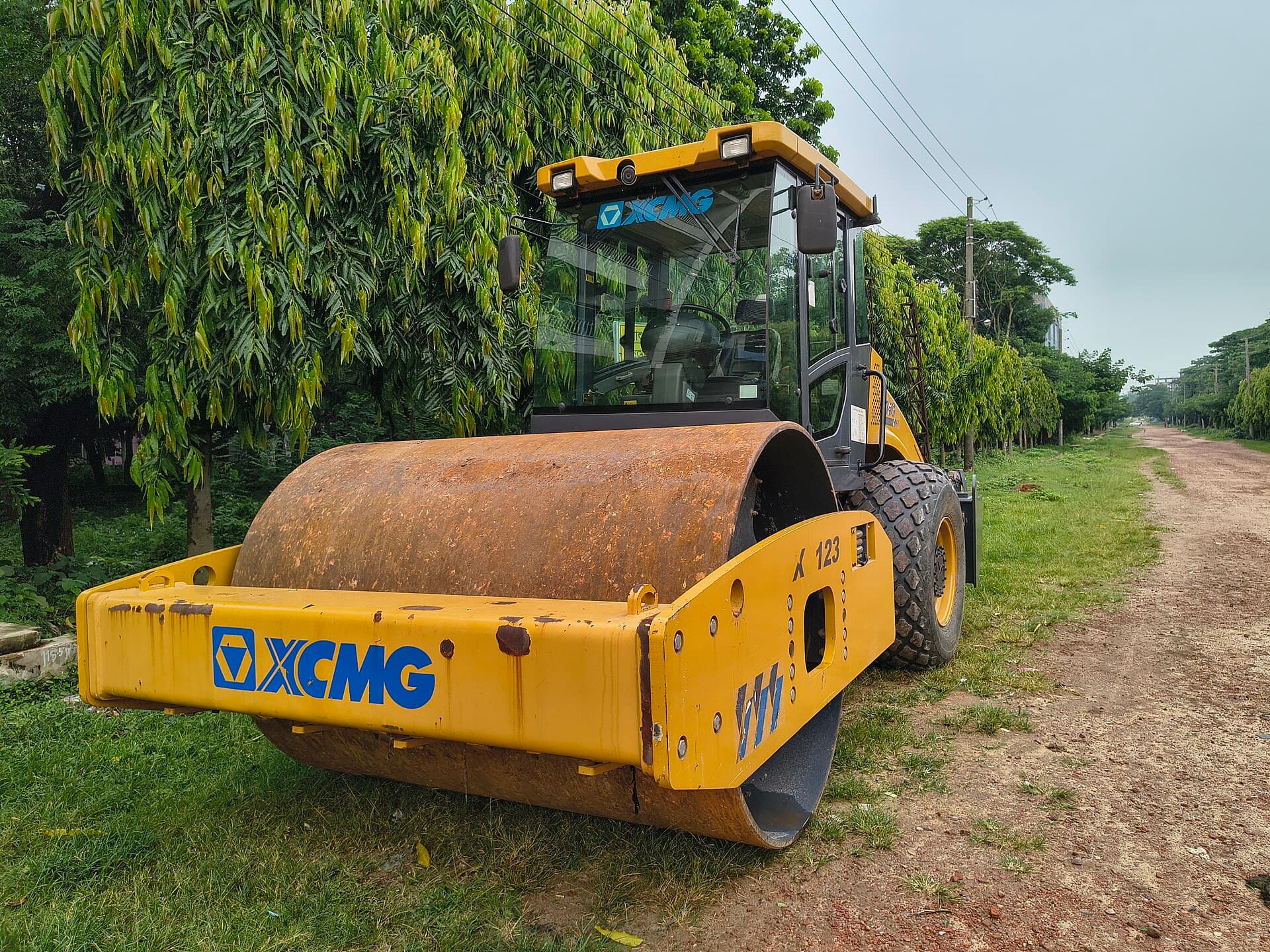
Vibratory Roller Specifications
The figures below describe typical industry specifications for this class of equipment rather than a single fixed model. Use them to scope a requirement, then confirm exact figures against the supplied unit before purchase.
| Specification | Typical value |
|---|---|
| Single-drum operating weight | 10–15 t typical for mine roads |
| Tandem (asphalt) weight | 7–13 t |
| Drum width | 2.1–2.2 m common |
| Centrifugal force | 200–300 kN high amplitude |
| Frequency | 28–35 Hz typical |
| Amplitude | 0.8–2.0 mm, high/low selectable |
| Engine power | 75–120 kW |
| Fuel consumption | 10–18 L/h |
| Drum type | Smooth for gravel and pads; padfoot for cohesive fill |
What a Vibratory Roller Is Used For
- Mine haul-road wearing course
- Plant pad and workshop floor formation
- Tailings-dam and bund construction
- Road and airstrip subgrade
- Trench backfill compaction
Maintenance Schedule
Most premature failures in this equipment class trace back to a missed routine check rather than a design fault. The intervals below are a practical starting schedule; adjust them to your duty cycle and the manufacturer manual.
| Interval | Task |
|---|---|
| Every shift | Check drum scrapers, water-spray nozzles (tandem) and vibration on/off function. |
| Daily | Engine oil, coolant, hydraulic leaks; drain drum-isolator breathers. |
| 250 h | Engine oil and filters; inspect drum isolators for cracking. |
| 500 h | Drum-drive oil; fuel filters; vibration-bearing temperature check. |
| Annually | Isolator replacement as a set if any have failed; eccentric-shaft inspection. |
Frequently Asked Questions
Smooth drum or padfoot?
Smooth drum for gravel, crushed stone and laterite wearing course. Padfoot (sheepfoot) for clay and cohesive fill that needs kneading. Running a smooth drum on fat clay polishes the surface and traps water; running padfoot on a finished gravel road destroys it.
How many passes does a roller need?
Enough to reach the specified dry density, which you confirm with a density test, not a pass count. Typical laterite wearing course is 6–8 passes at high amplitude with moisture near optimum. Dry material will not densify; wet material pumps. Add water or wait, rather than adding passes.
Why is my roller not compacting?
Wrong moisture, wrong amplitude, or the layer is too thick. Lift thickness should be about 150–250 mm loose for a 10–15 t soil roller. Trying to compact 400 mm in one lift leaves a crust over a soft core, which trucks then punch through.
Supply and Delivery Across Tanzania
Bart Mining supplies vibratory roller and related equipment to mining operations throughout Tanzania, with primary coverage of the Lake Victoria Goldfields (Mwanza, Kahama, Geita, Shinyanga and Bukombe), alongside the Lupa Goldfields around Chunya and Mbeya, and delivery nationwide from Dar es Salaam.
Request a quotation
Need a vibratory roller specified for your site?
Tell us your duty, depth or throughput and available power supply. We will come back with a specification and price, and flag anything on site that needs to change to make it work.