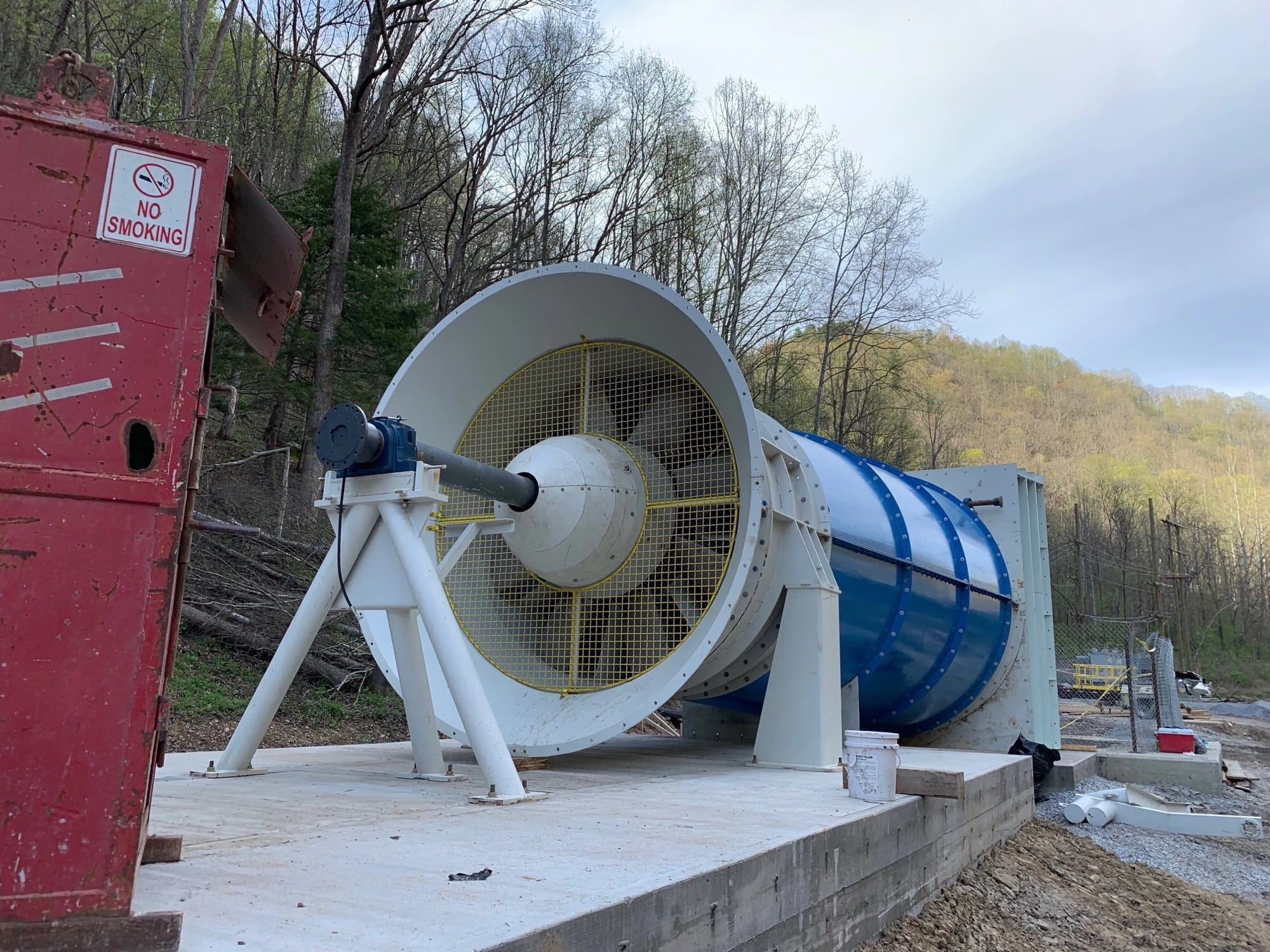
Mine Ventilation Fan Specifications
The figures below describe typical industry specifications for this class of equipment rather than a single fixed model. Use them to scope a requirement, then confirm exact figures against the supplied unit before purchase.
| Specification | Typical value |
|---|---|
| Auxiliary fan airflow | 1–20 m³/s |
| Fan pressure | 0.5–5 kPa depending on duct length |
| Fan type | Axial, single or contra-rotating; centrifugal for high pressure |
| Motor rating | 5.5–150 kW |
| Duct diameter | 400–1,200 mm |
| Duct type | Flexible layflat for forcing; rigid or reinforced for exhausting |
| Duct leakage | A major loss. Poorly jointed duct can lose over 40% of delivered air |
| Air per person | Commonly 0.1 m³/s minimum, per regulation |
| Air per diesel kW | Commonly 0.05–0.08 m³/s, per regulation |
| Noise | 85–105 dB(A) at 1 m; silencers available |
| Hazardous area | Flameproof motors required in gassy workings |
| Control | Direct-on-line, soft start or VFD for airflow trimming |
Mine Ventilation Fan: Uses and Applications
- Auxiliary ventilation of development headings
- Clearing blast fumes before re-entry
- Diluting diesel exhaust in loading areas
- Cooling deep or hot working faces
- Emergency smoke clearance
Maintenance Schedule
Most premature failures in this equipment class trace back to a missed routine check rather than a design fault. The intervals below are a practical starting schedule; adjust them to your duty cycle and the manufacturer manual.
| Interval | Task |
|---|---|
| Every shift | Confirm the fan is running and duct is inflated along its full length; look for tears and disconnected joints. |
| Weekly | Measure airflow at the face, not at the fan. The difference is duct leakage and it tells you what to fix. |
| Monthly | Inspect impeller for dust build-up and blade damage; check motor bearing temperature and vibration. |
| Quarterly | Electrical inspection including cable and isolator; verify flameproof enclosure integrity where fitted. |
| Annually | Full ventilation survey of the mine with airflow measurement at all key stations. |
Frequently Asked Questions
How much air does an underground mine need?
Take the largest of three calculations: minimum air per person underground, air per kilowatt of operating diesel equipment, and the volume required to clear blast fumes within the planned re-entry time. Diesel equipment usually dominates and is where operators most often under-provide.
Forcing or exhausting ventilation?
Forcing pushes fresh air to the face through duct and clears fumes back along the heading. It is simpler and uses cheap layflat duct, but workers travel through contaminated return air. Exhausting draws contaminated air out through rigid duct, keeping the heading clean, but costs more and the duct must resist collapse. Many operations use a forcing-exhausting overlap system.
Why is my ventilation fan not delivering air at the face?
Almost always duct leakage. Torn layflat, badly made joints and crushed sections can lose over 40% of the fan output before it reaches the face. Measuring airflow at the fan tells you nothing useful; measure at the face and treat the gap as the maintenance backlog.
When are flameproof fan motors required?
Wherever flammable gas may be present. Standard motors are an ignition source. Where methane or other flammable gas has ever been detected, ventilation equipment must be certified for the hazardous zone classification of that working.
Supply and Delivery Across Tanzania
Bart Mining supplies mine ventilation fan and related equipment to mining operations throughout Tanzania, with primary coverage of the Lake Victoria Goldfields (Mwanza, Kahama, Geita, Shinyanga and Bukombe), alongside the Lupa Goldfields around Chunya and Mbeya, and delivery nationwide from Dar es Salaam.
Commonly supplied to: Kahama, Mererani.
Manufacturer or supplier of this equipment? Bart Mining sells machinery like the mine ventilation fan to buyers across Tanzania through its local market partnership.