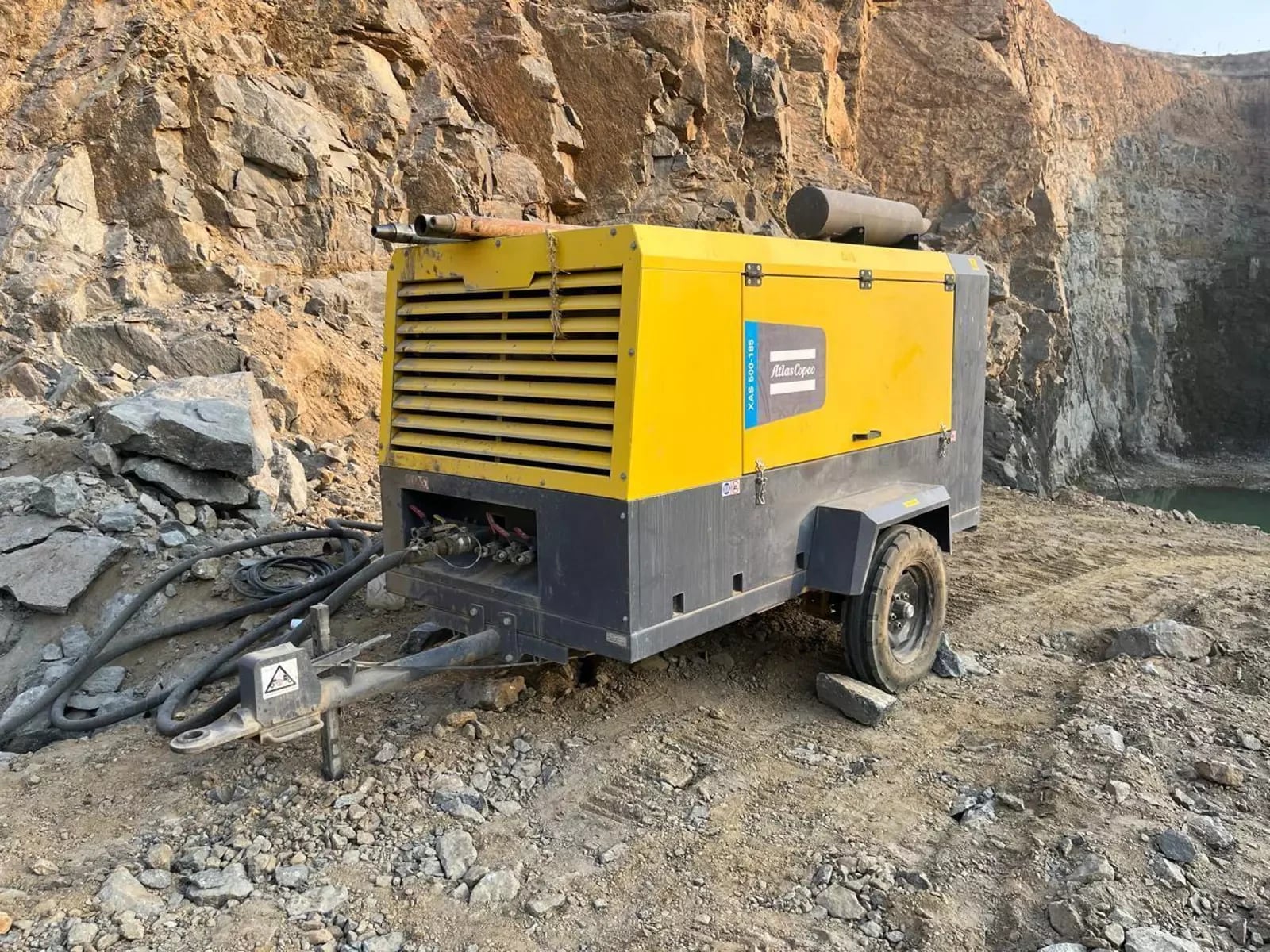
Mining Air Compressor Specifications
The figures below describe typical industry specifications for this class of equipment rather than a single fixed model. Use them to scope a requirement, then confirm exact figures against the supplied unit before purchase.
| Specification | Typical value |
|---|---|
| Rock drill duty | 100–150 cfm at 6–7 bar per drill |
| RC drilling duty | 900–1,150 cfm at 24–35 bar |
| Booster | Raises pressure to 35–50 bar for deep RC holes |
| Compressor type | Rotary screw for continuous duty; piston for intermittent |
| Drive | Diesel for mobile; electric for fixed plant |
| Power requirement | Roughly 0.12–0.15 kW per cfm at 7 bar |
| Cooling | Air-cooled standard; water-cooled for high ambient or continuous duty |
| Air receiver | Sized to damp demand surges and separate condensate |
| Air treatment | Aftercooler, water separator and filtration; dryer for instrument air |
| Pressure drop allowance | Keep pipeline losses under 10% from compressor to tool |
| Ingress and dust | Heavy-duty intake filtration essential in mining environments |
| Service interval | 500–2,000 h depending on type and conditions |
Mining Air Compressor: Uses and Applications
- Jackleg and stoper rock drilling
- Reverse circulation drilling air supply
- Pneumatic loaders, winches and pumps
- Shotcrete and grouting equipment
- Plant instrument air and cleaning
Maintenance Schedule
Most premature failures in this equipment class trace back to a missed routine check rather than a design fault. The intervals below are a practical starting schedule; adjust them to your duty cycle and the manufacturer manual.
| Interval | Task |
|---|---|
| Daily | Drain condensate from the receiver and separators; check oil level and intake filter restriction indicator. |
| Weekly | Clean or replace intake filters. Dust loading in mining environments is far higher than industrial ratings assume. |
| Monthly | Check for air leaks across the whole distribution system; leaks commonly waste 20–30% of compressor output. |
| 500–2,000 h | Oil and oil-filter change, separator element replacement, belt and coupling inspection. |
| Annually | Pressure vessel inspection and certification of the air receiver; safety valve test. |
Frequently Asked Questions
What size compressor do I need for rock drills?
Allow 100–150 cfm at 6–7 bar per drill, then add for simultaneous use and pipeline losses. Four jacklegs working together need roughly 500–600 cfm at the compressor, not 400, once leakage and pressure drop are accounted for.
Why does RC drilling need such high pressure?
Because the air must lift rock cuttings from the bottom of the hole all the way to surface through the annulus of the dual-wall pipe. As the hole deepens the column of cuttings gets taller and heavier, so pressure demand rises with depth. This is why boosters become necessary past about 200 m.
Screw or piston compressor for mining?
Screw, for almost all mining duty. Piston compressors are cheaper and fine for intermittent workshop use, but they run hot on continuous duty and tolerate dust badly. Screw compressors are designed for 100% duty cycle and last far longer in mining conditions.
How much air is lost to leaks?
Commonly 20–30% of total output on a mine air system that has never been surveyed, and sometimes more. Leak detection and repair is usually the cheapest capacity increase available, and considerably cheaper than buying another compressor to feed the leaks.
Supply and Delivery Across Tanzania
Bart Mining supplies mining air compressor and related equipment to mining operations throughout Tanzania, with primary coverage of the Lake Victoria Goldfields (Mwanza, Kahama, Geita, Shinyanga and Bukombe), alongside the Lupa Goldfields around Chunya and Mbeya, and delivery nationwide from Dar es Salaam.
Commonly supplied to: Singida, Handeni, Dar es Salaam, Mererani.
Manufacturer or supplier of this equipment? Bart Mining sells machinery like the mining air compressor to buyers across Tanzania through its local market partnership.