Leach Tank Volume Calculator for CIL and CIP Plants
How big do the leach tanks need to be for your plant? The volume comes from the slurry flow and the time your ore needs to leach. Enter your tonnes per day, slurry density, ore specific gravity and the residence time from your leach test, and the calculator gives the working volume and the volume of each tank.
Unasoma Kiswahili? Tumia kikokotoo kwa Kiswahili
Results
- Slurry flow
- 3.32 m³/h
- Working volume needed
- 79.6 m³
- Volume with allowance
- 87.6 m³
- Volume per tank
- 14.6 m³
A planning estimate only. It excludes freeboard, carbon volume and design margins; a process designer confirms tank geometry, agitators and screens from your test results.
How the calculation works
The calculator first converts your daily tonnage into tonnes of solids per hour over the plant’s operating hours. It then works out the slurry volume those solids make up with their water: the solids volume is the tonnage divided by the ore’s specific gravity, and the water volume follows from the percentage of solids by mass. Multiplying the slurry flow by the residence time gives the working volume the tank train must hold. A planning allowance is added, and the total is divided by the number of tanks.
A worked example
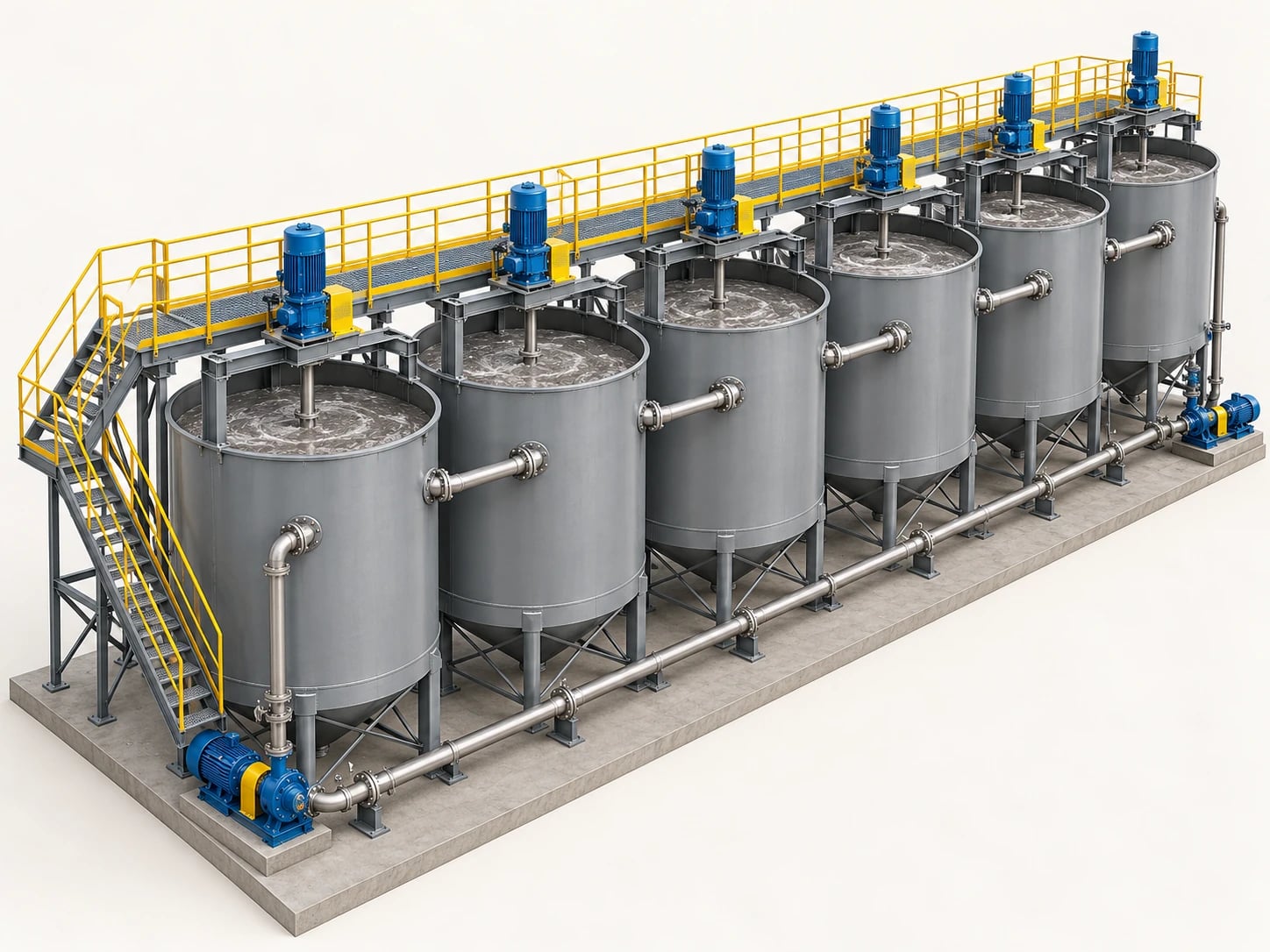
The default values show a plant treating 50 tonnes a day over 24 hours at 45% solids, with ore of specific gravity 2.7 and a 24-hour leach. The slurry flow is about 3.3 m³ per hour, so the working volume is about 79.6 m³. With a 10% allowance that becomes about 87.6 m³, or six tanks of about 14.6 m³ each. These inputs are assumptions to show the method; use your own tonnage and the residence time from a leach test on your ore.
What the result does not include
The figure is a working volume for planning. It does not include freeboard above the slurry, the volume taken by carbon and screens, or the margins a designer applies. Agitator power, screen size, air supply and tank shape all need a process design based on your test results. The leaching tank page explains tank construction and maintenance, and the small CIP and CIL plant guide covers the rest of the circuit.
Size your leach train
Send us your tonnage & leach test
Share your tonnes per day, slurry density, leach test results and site power, and we will help you specify the tanks, agitators and screens together.