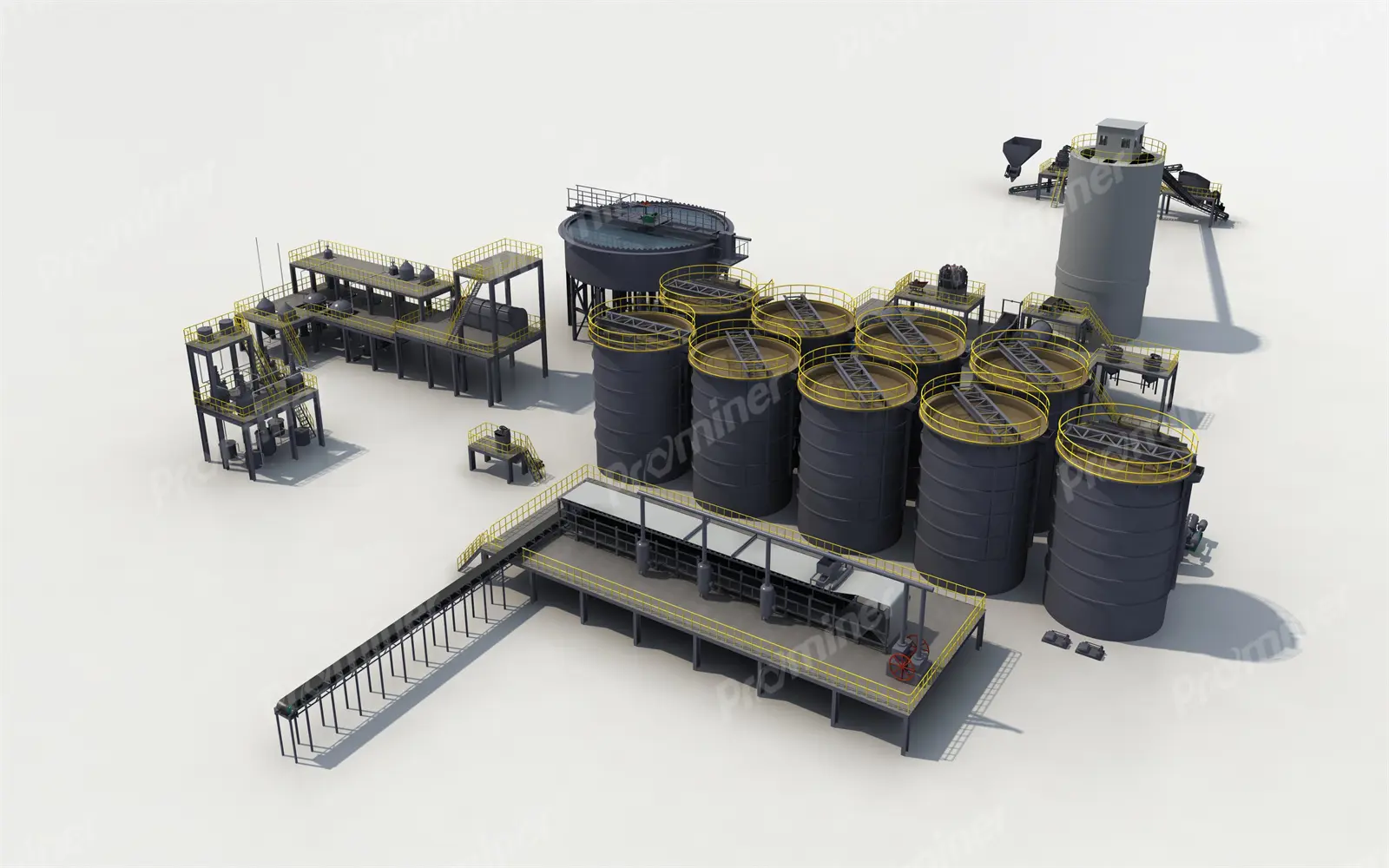
Why Small Miners Are Moving to Tank Leaching
Across Geita, Chunya, Kahama and Tarime, small-scale operations have been adding tank leaching behind their gravity circuits. The reason is simple arithmetic. Gravity and amalgamation typically leave a large share of the gold in the tailings, and a leach circuit can recover most of what is left. On suitable ore, moving from gravity alone to gravity plus CIP or CIL lifts recovery from somewhere around 50 to 80 percent to 88 to 95 percent.
This guide covers what a small tank circuit consists of, how CIL and CIP differ at small scale, and the numbers you need before buying. For the wider comparison including heap leach, see CIL vs CIP vs heap leach.
What a Small Plant Consists Of
- Crushing and milling. A jaw crusher and ball mill in closed circuit with a cyclone, grinding to roughly 80 percent passing 75 to 150 microns
- Gravity recovery. A centrifugal concentrator in the mill circuit takes out coarse free gold before it reaches the tanks
- Thickening or dewatering to bring slurry to 40 to 50 percent solids
- Leach and adsorption tanks. Five to eight agitated leaching tanks in series, with lime for pH control and air for dissolved oxygen
- Interstage screens that hold carbon in each tank while slurry flows on
- Carbon handling: pumping carbon counter-current to the slurry and recovering loaded carbon from the first tank
- Elution and electrowinning, owned or tolled, to strip gold from the carbon
- Tailings storage, lined and permitted, with cyanide detoxification where required
- A small laboratory for cyanide, pH and solution assays every shift
CIL or CIP at Small Scale
| CIL (carbon in leach) | CIP (carbon in pulp) | |
|---|---|---|
| How it works | Leaching and carbon adsorption in the same tanks | Leach tanks first, then separate adsorption tanks with carbon |
| Number of tanks | Fewer for the same tonnage | More, because leach and adsorption are split |
| Capital | Lower | Higher |
| Carbonaceous (preg-robbing) ore | Better, carbon grabs gold before the ore does | Weaker |
| Carbon loading and control | Slightly lower loading, carbon exposed longer | Higher loading, each step easier to control |
| Usual choice for small plants | Most new builds | Where ore is clean and operators want tighter control |
For most small Tanzanian plants built today, CIL is the practical default because it needs fewer tanks. The local habit of calling any tank plant a "CIP" is fine in conversation, but make sure the supplier's drawings show which one you are actually buying.
Sizing the Tanks
Tank volume is set by throughput, slurry density and residence time. The logic is straightforward:
- Daily slurry volume comes from tonnes of ore per day and the percentage of solids
- Residence time, commonly 18 to 36 hours in total, comes from leach test work on your ore, not from a catalogue
- Total tank volume is the slurry volume per hour multiplied by the residence time, plus freeboard
- That volume is split across the number of tanks, usually equal-sized for simpler spares and maintenance
As an illustration only: a 50 tonne per day plant at 45 percent solids and 24 hours residence needs a total working volume in the order of 90 to 100 cubic metres, which might be six tanks of roughly 17 to 20 cubic metres each. Your ore may need longer or shorter residence, which is why test work comes first.
Consumables Per Tonne
Reagent consumption varies widely with ore type, and the only reliable figures come from a bottle roll on your own sample. The items to model per tonne are:
- Sodium cyanide. Consumption rises sharply with copper minerals and sulphides in the ore
- Lime to hold pH above about 10.5, which also keeps toxic HCN gas from forming
- Activated carbon make-up to replace carbon lost to breakage
- Grinding media and mill liners, which on abrasive Geita ore can outweigh reagents
- Power or diesel for the mill and agitators, usually the largest single line
For where these reagents come from and how to keep supply reliable, see activated carbon and cyanide supply in Tanzania.
The Mistakes That Cost the Most
- Building tanks before testing the ore. Too little residence time leaves gold undissolved; too much wastes steel and cyanide
- Skipping gravity. Coarse gold dissolves slowly and passes through the tanks. A concentrator ahead of the tanks is cheap insurance
- Grinding too coarse to save mill capacity, which locks gold inside particles the cyanide never reaches
- Poor carbon management. Carbon that is never regenerated, or lost through worn interstage screens, silently lowers recovery
- Treating tailings as an afterthought. Unlined or poorly built tailings storage is the fastest way to have a plant closed by an inspector
Permits Before Steel
A tank leach plant uses cyanide, so it needs environmental approval, a compliant tailings facility, and cyanide storage and handling procedures before it runs. The Mining Commission's 2026 inspections of small-scale projects found repeated shortcomings in environmental management plans, mining plans and mine opening plans. Build the compliance documents alongside the plant design, not after commissioning.
Regions We Serve
Frequently Asked Questions
What is the smallest CIP or CIL plant worth building?
Below about 20 to 30 tonnes per day, a full tank train rarely pays for itself. At that scale, gravity recovery plus vat leaching of the tailings, or selling concentrate and tailings to a larger plant, is usually the better economic answer.
Can I add tanks to my existing gravity plant?
Often, yes. The mill and cyclone need to produce a fine enough grind for leaching, and the plant needs space for tanks, a thickener or dewatering step, and tailings storage. Check the grind first: many gravity plants run coarser than a leach circuit needs.
Can a tank plant treat old tailings (marudio)?
Yes. Many small plants in Tanzania run on reprocessed amalgamation tailings. Test them first, because old tailings vary in grade, may have been partly leached before, and can contain mercury that has to be managed.
How long does it take to build a small tank plant?
Plan on three to six months from order to first gold for a modular plant, once fabrication, transport, civil works and commissioning are counted. Permits and site preparation are more often the delay than the equipment.