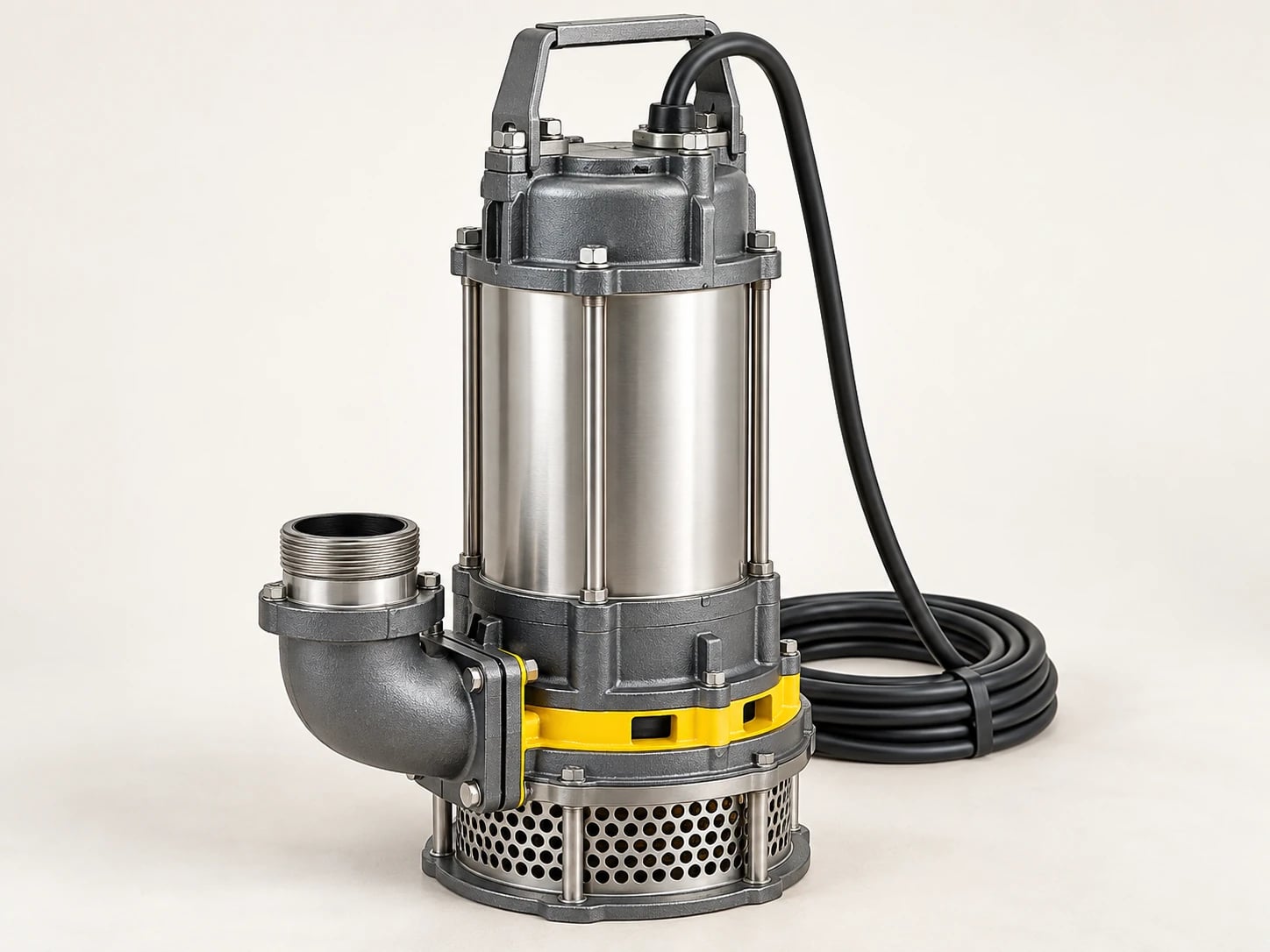
Submersible Dewatering Pump Specifications
The figures below describe typical industry specifications for this class of equipment rather than a single fixed model. Use them to scope a requirement, then confirm exact figures against the supplied unit before purchase.
| Specification | Typical value |
|---|---|
| Flow range | 5–500 m³/h |
| Head range | 10–120 m per stage |
| Solids handling | Up to 10–35 mm depending on model |
| Motor rating | 1.5–90 kW |
| Power supply | 400 V 3-phase 50 Hz |
| Motor cooling | Pumped-liquid jacket cooling |
| Motor protection | Thermal cut-out plus moisture sensor in the seal chamber |
| Seal arrangement | Double mechanical seal in an oil chamber |
| Casing material | Cast iron or high-chrome for abrasive water |
| Cable | Heavy-duty submersible cable, length specified to surface |
| Discharge | Hose or steel column pipe |
| Staging | Series pumping with intermediate sumps beyond ~80 m |
Submersible Dewatering Pump: Uses and Applications
- Shaft and decline dewatering
- Sump and pit water removal
- Emergency flood response
- Alluvial pit and river-bed working
- Construction and pad drainage
Maintenance Schedule
Most premature failures in this equipment class trace back to a missed routine check rather than a design fault. The intervals below are a practical starting schedule; adjust them to your duty cycle and the manufacturer manual.
| Interval | Task |
|---|---|
| Every shift | Confirm the pump is running and discharging expected flow; check the strainer is not blinded by silt or debris. |
| Weekly | Inspect the power cable full length for damage, especially at the gland and any hanging points. |
| Monthly | Check seal chamber oil for water contamination. Milky oil means the outer seal has failed and the motor is next. |
| Quarterly | Measure motor insulation resistance; inspect impeller and wear ring clearance. |
| Annually | Full strip, seal replacement and electrical test before the wet season. |
Frequently Asked Questions
How do I size a dewatering pump for a shaft?
Measure or estimate the inflow rate, add margin for wet-season peaks, then calculate total head as vertical lift plus pipe friction losses. Friction is routinely underestimated: a long small-bore hose can add more head than the shaft depth itself. Size on total head, never on depth alone.
Can one pump dewater a deep shaft?
Rarely beyond about 80 m. Beyond that, staging pumps in series with intermediate sumps is more reliable and far more energy-efficient, and it means a single failure floods one stage rather than the whole shaft. Staging also lets you use smaller, more easily handled units.
What does milky oil in the seal chamber mean?
Water has passed the outer mechanical seal. The inner seal is still protecting the motor, but it is now the only barrier. Change the oil and seals at that point. Continuing to run reliably ends in a burnt-out motor and a much larger bill.
Can a submersible pump handle muddy water with sand?
Yes within limits, but sand accelerates wear enormously. For persistently sandy water, specify a high-chrome wet end and an agitator model designed for slurry, and accept a shorter service interval. A standard clean-water submersible in sandy sump duty may last only weeks.
Supply and Delivery Across Tanzania
Bart Mining supplies submersible dewatering pump and related equipment to mining operations throughout Tanzania, with primary coverage of the Lake Victoria Goldfields (Mwanza, Kahama, Geita, Shinyanga and Bukombe), alongside the Lupa Goldfields around Chunya and Mbeya, and delivery nationwide from Dar es Salaam.
Commonly supplied to: Mwanza, Kahama, Tarime, Shinyanga, Musoma and Butiama, Handeni, Mererani.
Manufacturer or supplier of this equipment? Bart Mining sells machinery like the submersible dewatering pump to buyers across Tanzania through its local market partnership.