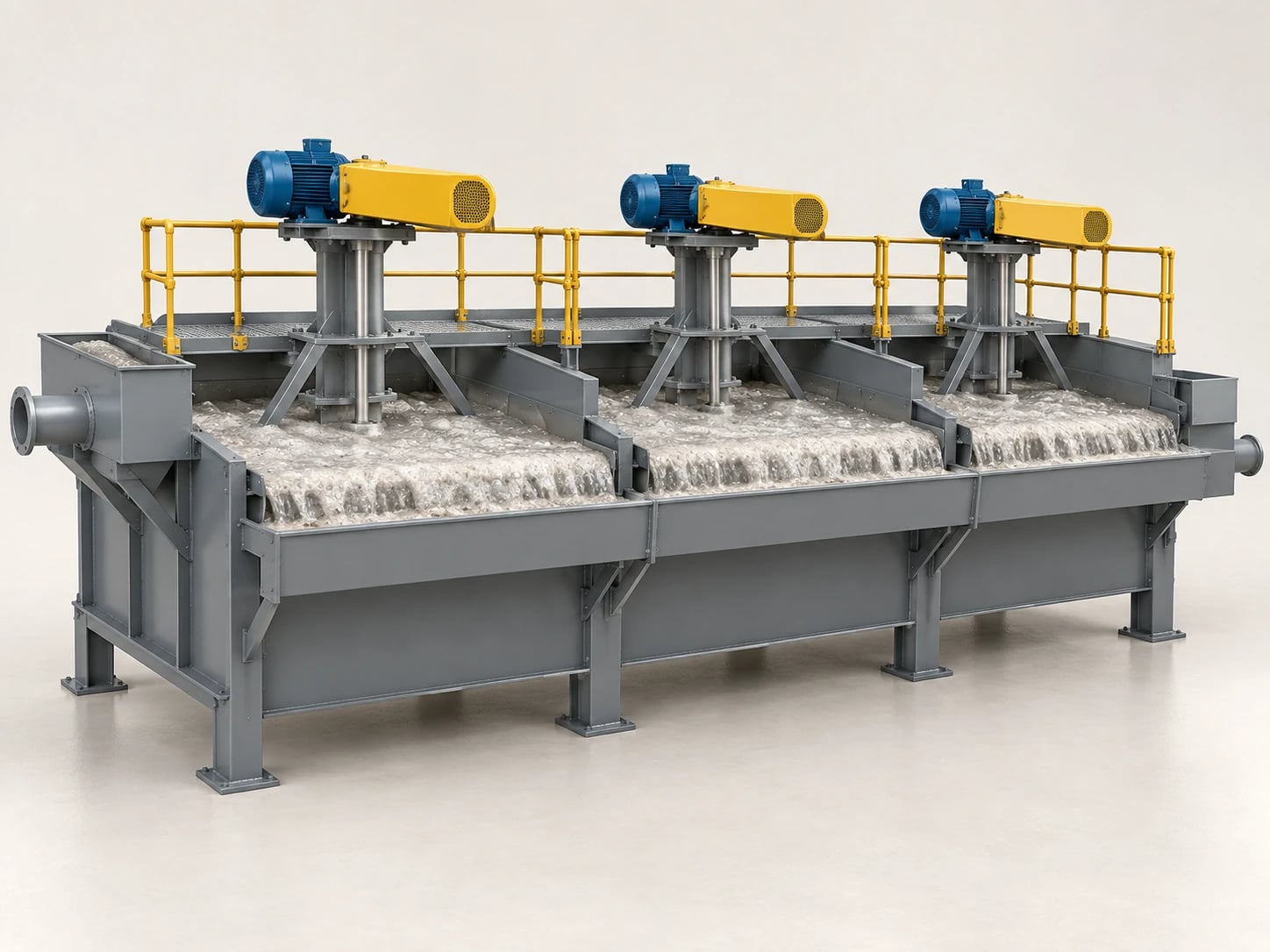
Froth Flotation Cell Specifications
The figures below describe typical industry specifications for this class of equipment rather than a single fixed model. Use them to scope a requirement, then confirm exact figures against the supplied unit before purchase.
| Specification | Typical value |
|---|---|
| Principle | Selective attachment of hydrophobic minerals to air bubbles |
| Cell types | Mechanical self-aspirating, forced-air tank cells and column cells (often for cleaning) |
| Cell volume | From under 1 m³ on pilot and small plants to tens of m³ per cell on large plants |
| Feed | Ground slurry at the liberation size set by test work |
| Pulp density | Commonly 25–40% solids by mass in roughers; lower in cleaners |
| Circuit stages | Rougher, scavenger and one or more cleaner stages, often with regrinding |
| Reagents | Collector, frother and, where needed, depressants and pH modifiers |
| Residence time | Scaled up from laboratory flotation kinetics by the designer |
| Construction | Steel tanks; rubber-covered or hardened impellers and stators |
| Power supply | Continuous electric supply for impellers or air blowers |
Froth Flotation Cell: Uses and Applications
- Copper sulphide ore concentration
- Flake graphite concentration with staged cleaning
- Nickel and other base-metal sulphide concentrates
- Lithium (spodumene) flotation where dense media separation alone is not enough
- Sulphide gold ores that need a concentrate before further treatment
Maintenance Schedule
Most premature failures in this equipment class trace back to a missed routine check rather than a design fault. The intervals below are a practical starting schedule; adjust them to your duty cycle and the manufacturer manual.
| Interval | Task |
|---|---|
| Every shift | Check froth depth and colour, air flow and reagent dosing; confirm every impeller is turning and the level controls are working. |
| Weekly | Inspect froth launders and concentrate pumps for blockages; check reagent pumps against their calibration. |
| Monthly | Inspect impeller and stator wear, drive belts and air distribution; sample streams for a metallurgical balance. |
| Annually | Drain and inspect tank linings, replace worn impellers and stators, and recalibrate level and air instruments. |
Frequently Asked Questions
Can flotation recover free gold?
Flotation can recover gold carried in sulphide minerals and some free gold, but coarse free gold is usually better recovered by gravity first. Most gold plants use gravity and leaching; flotation is chosen when the ore is sulphide-rich or when a concentrate must be produced for sale or further treatment. Test work on your ore decides it.
How many cells does a flotation circuit need?
The number comes from the residence time the laboratory tests show, scaled up for the plant, divided across cells of a practical size, then split into rougher, scavenger and cleaner banks. A small plant may use only a few cells per stage; a graphite circuit often needs several cleaning stages to reach a saleable grade.
What do I need before ordering flotation equipment?
A representative sample, mineralogy, grind and flotation tests that show grade and recovery at each stage, the reagent scheme, the tonnes per day to treat and reliable power and water. Without those, cell sizing is a guess.
Why does flotation need steady operation?
Froth depth, air, reagent addition and pulp density all affect grade and recovery, and a change in one shifts the others. Plants that hold these steady and sample the streams regularly get far more consistent results than those adjusted by eye.
Supply and Delivery Across Tanzania
Bart Mining supplies froth flotation cell and related equipment to mining operations throughout Tanzania, with primary coverage of the Lake Victoria Goldfields (Mwanza, Kahama, Geita, Shinyanga and Bukombe), alongside the Lupa Goldfields around Chunya and Mbeya, and delivery nationwide from Dar es Salaam.