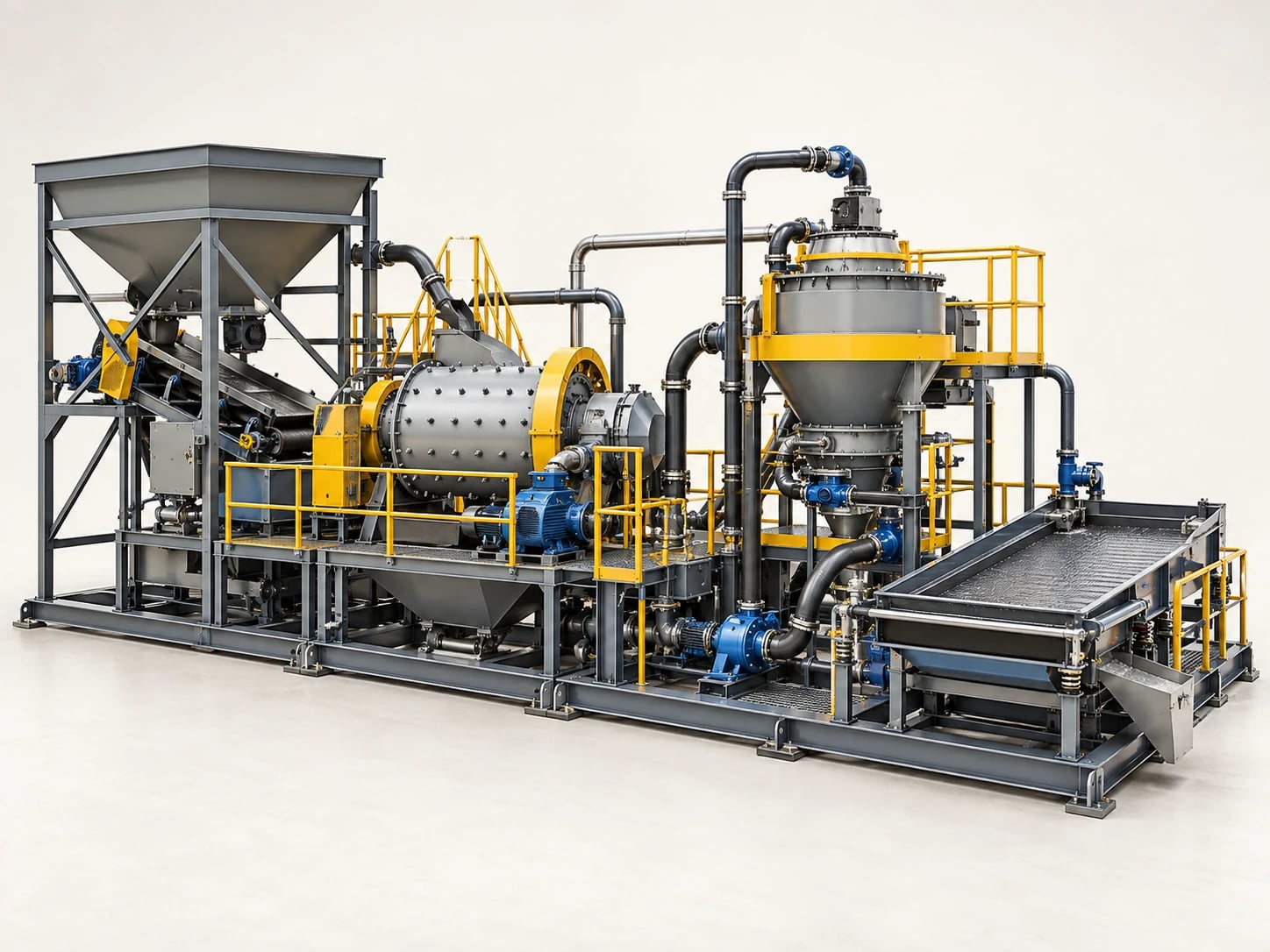
Modular Gold Processing Plant Specifications
The figures below describe typical industry specifications for this class of equipment rather than a single fixed model. Use them to scope a requirement, then confirm exact figures against the supplied unit before purchase.
| Specification | Typical value |
|---|---|
| Throughput range | 10–500 t/day |
| Configuration | Container, skid or trailer mounted |
| Typical circuit | Jaw crusher, ball mill, cyclone, gravity concentrator, optional CIL |
| Installed power | 80–800 kW depending on capacity |
| Water demand | 0.5–1.5 m³ per tonne with recycling |
| Footprint | From roughly 20 × 30 m for a 50 t/day plant |
| Civil works | Level compacted pad and modest concrete plinths |
| Installation time | 3–10 weeks from delivery to commissioning |
| Transport | Standard 20 ft and 40 ft containers or flat racks |
| Relocatability | Designed for disassembly and redeployment |
Modular Gold Processing Plant: Uses and Applications
- Remote and greenfield project development
- Pilot plants and bulk sampling campaigns
- Small to medium production operations
- Central processing for cooperatives of small miners
- Temporary capacity while a fixed plant is built
Maintenance Schedule
Most premature failures in this equipment class trace back to a missed routine check rather than a design fault. The intervals below are a practical starting schedule; adjust them to your duty cycle and the manufacturer manual.
| Interval | Task |
|---|---|
| Every shift | Circuit walk-down: check feed rate, water balance, screen condition and slurry lines for wear. |
| Weekly | Liner and wear-part inspection across crusher, mill and pumps; grease programme. |
| Monthly | Mill liner thickness survey; cyclone apex and vortex finder wear; conveyor belt tracking. |
| Quarterly | Structural bolt check on all modules; electrical panel thermographic survey. |
| Annually | Full circuit audit including mass balance and recovery reconciliation. |
Frequently Asked Questions
How long does a modular gold plant take to commission?
Typically 3–10 weeks from arrival on site, against six months or more for a conventional built-in-place plant. The saving comes from the modules being pre-assembled, wired and tested at the fabricator, so site work is largely positioning, connecting and commissioning.
What power supply does a modular plant need?
80–800 kW depending on capacity, at 400 V three phase 50 Hz. Grid connection is preferable where available in Geita or Mwanza; otherwise size a diesel genset with at least 25% headroom above calculated running load to absorb mill starting current and load swings.
How much water does a modular gold plant use?
0.5–1.5 m³ per tonne of ore with a functioning recycle circuit, and far more without one. In water-constrained districts a thickener and return-water system is not an optional extra. It usually determines whether the site is viable at all.
Can a modular plant be moved to another site?
Yes, that is a core design intent. Modules unbolt, load onto standard transport and redeploy. This suits operations working a series of small deposits, and it protects capital where an orebody is smaller than expected.
Supply and Delivery Across Tanzania
Bart Mining supplies modular gold processing plant and related equipment to mining operations throughout Tanzania, with primary coverage of the Lake Victoria Goldfields (Mwanza, Kahama, Geita, Shinyanga and Bukombe), alongside the Lupa Goldfields around Chunya and Mbeya, and delivery nationwide from Dar es Salaam.
Commonly supplied to: Geita, Dar es Salaam.
Manufacturer or supplier of this equipment? Bart Mining sells machinery like the modular gold processing plant to buyers across Tanzania through its local market partnership.