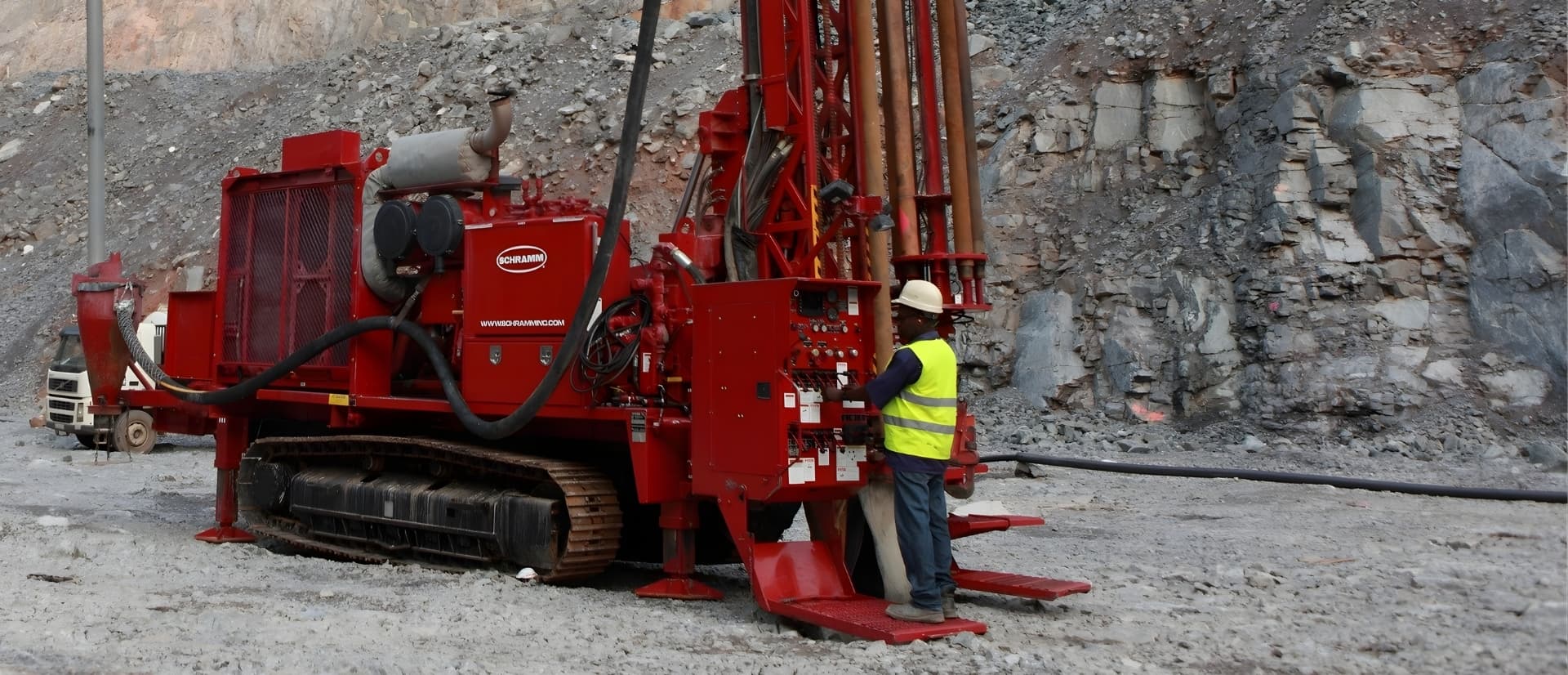
Drill Methods Used in Tanzania
Diamond Core Drilling
Diamond core drilling uses a rotating coring bit impregnated with industrial diamonds to cut a continuous cylindrical rock sample (the core) from the drill string's inner tube. It is the gold standard for geological logging, geotechnical characterisation and JORC-compliant resource estimation because it provides an intact, orientable core sample that can be photographed, logged, split and assayed with full chain-of-custody documentation.
Standard core sizes used in Tanzania are HQ (63.5 mm core diameter) and NQ (47.6 mm). HQ is preferred where competent, fresh rock allows full core recovery and where structural measurements are needed. NQ reduces rod weight and cost in deep holes. PQ (85 mm) is occasionally used in weak or friable materials to improve recovery.
Reverse Circulation (RC) Drilling
RC drilling uses compressed air to return cuttings up the inner tube of a dual-wall drill string, preventing cross-contamination between sample intervals. It is significantly faster and cheaper than diamond drilling (typically 3–5× greater daily penetration rates) and is well-suited to:
- Oxide ore zones where core recovery is poor
- Initial resource scout drilling programmes requiring fast spatial coverage
- Grade-control drilling at producing mines
- Pre-collars above planned diamond core intervals
RC sample quality can be compromised by water influx, cyclone moisture and sample splitting errors. rigorous protocols are essential for programmes that will be used in resource estimates.
Sample Management & QA/QC in Tanzania
On-Site Procedures
A robust sampling protocol begins at the rig. Core must be photographed in the core tray immediately after extraction, before any logging or sampling. Core intervals are marked by the geologist and split longitudinally using a diamond blade core saw (or spear for friable material), with one half retained as a reference. RC chips are split using a riffle splitter or rotary splitter to obtain a representative ~3 kg sample per interval.
QA/QC Programme Design
All sample batches dispatched to the assay laboratory must contain a systematic QA/QC suite:
- Certified Reference Materials (CRMs), at minimum one CRM per 20 samples, spanning the grade range of mineralised material
- Coarse blanks. crushed barren rock, inserted to detect cross-contamination in the sample preparation circuit
- Field duplicates. quarter-core or split-RC duplicates to assess sampling precision
- Pulp duplicates. sent to an oven laboratory for check assaying
QA/QC results must be reviewed and documented in the database before any resource estimates are prepared. Failures. CRM values outside ±2σ of certified value, blank contamination above threshold, poor duplicate precision. require investigation and potential re-assaying of affected batches.
Contract Drilling in Tanzania: Selection Criteria
Several international and regional contract drilling companies operate in Tanzania, including Geodrill, African Drilling, Boart Longyear and several Tanzanian-registered operators. Key criteria for contractor selection include:
- Equipment capability and condition (rod string size, pump capacity, rig age)
- Trained and certified drillers (AWID/DCDNA accreditation preferred)
- Availability of spare parts in-country or rapid import capability
- Health, safety and environment (HSE) management systems and lost-time injury frequency
- Environmental drill water management and drill mud handling
- Community relations track record in Tanzania specifically
Logistics & Access
Most exploration targets in Tanzania can be accessed by four-wheel-drive vehicle during the dry season (June–October). The Lake Victoria goldfields are accessible year-round via tarmac from Mwanza. The Dodoma region has improved road access following recent infrastructure investment. Remote projects in the Selous Game Reserve buffer zone or Rukwa Region require helicopter support or extended dry-season access plans.